
CRAFT
Three techniques decide what a piece can be: Florentine hand engraving, Tulle openwork, and Chengdu lacquer. None of them is a finish applied at the end. Each one changes the structure, the weight, and what the piece looks like after thirty years of wear.
Florentine engraving is the studio's oldest habit. A steel burin is pushed across the metal by hand, cutting a shallow V rather than scraping a line. Two or three sets of parallel cuts are laid across each other at different angles, so the surface is not a pattern but a field of tiny facets.
The order of work is unforgiving: the piece is polished first, engraved second, and never polished again. Polishing after the cut would round over the ridges that catch the light. Under a raking light you can see that no two cuts are the same depth or the same distance apart — the hand is visible, and that is the point.
The alloy matters more than people expect. Gold that is too soft smears under the burin instead of cutting; the studio works in 18K for exactly this reason. The engraving can be re-cut years later if it wears — which is also why the metal is made thick enough to survive being cut twice.
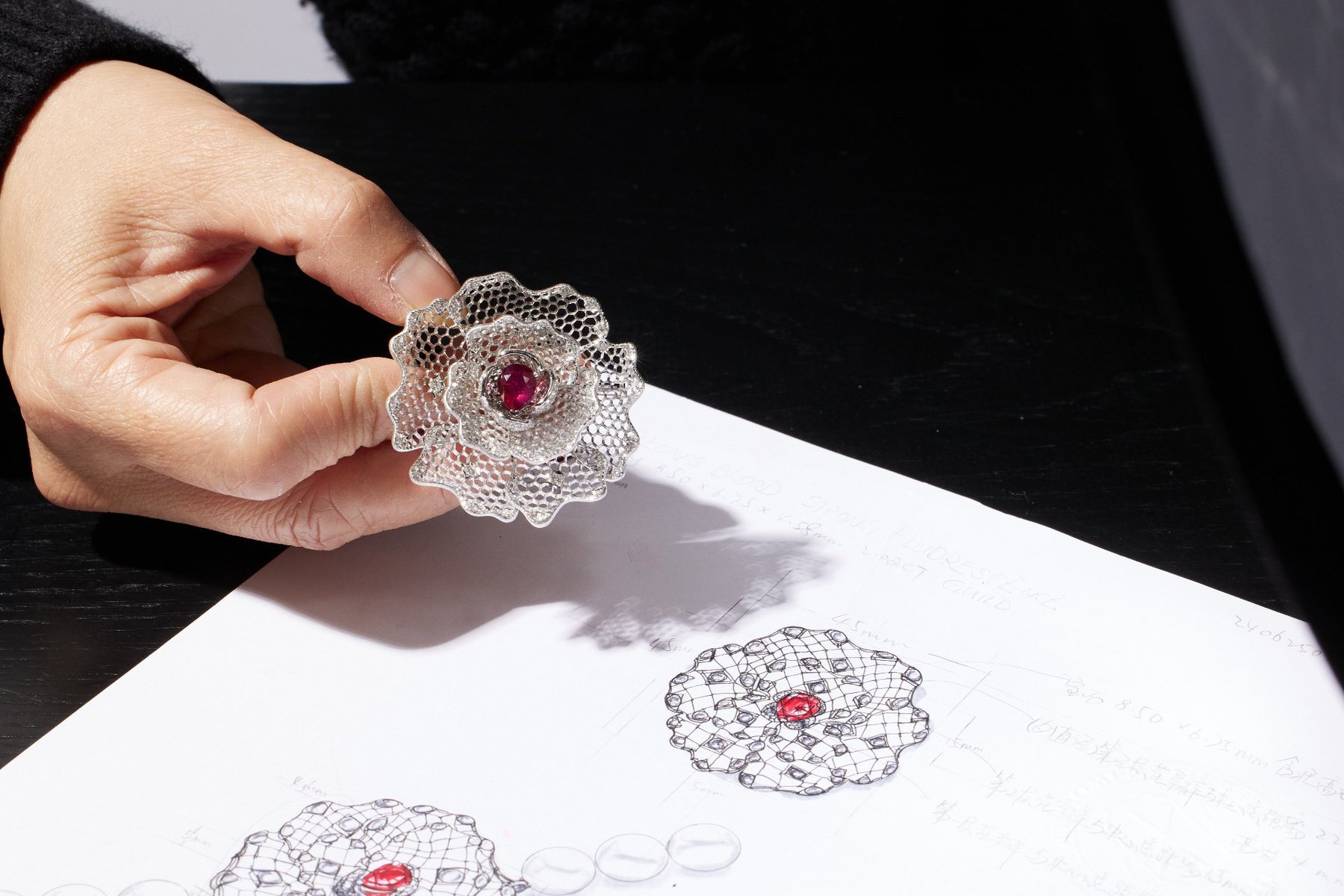
Tulle openwork under raking light. The cells are cut, filed and reworked by hand; none of them is perfectly identical.
Tulle is openwork cut with a saw, not a drill. The metal is pierced into a honeycomb until it behaves like fabric: it holds the stones, spreads the load, and stops being visible as metal. Each cell is filed and reworked at least five times before the piece is accepted.
This is the hardest work in the studio, and the reason a large piece can weigh almost nothing on the hand. It also has a practical consequence: a pierced surface lets air and light through, so a red stone stays red instead of going dark in a closed setting.
Engraving and openwork are often used together — the sawn cells give the structure, the burin gives the surface. A piece can take weeks of cutting before a single stone is set.
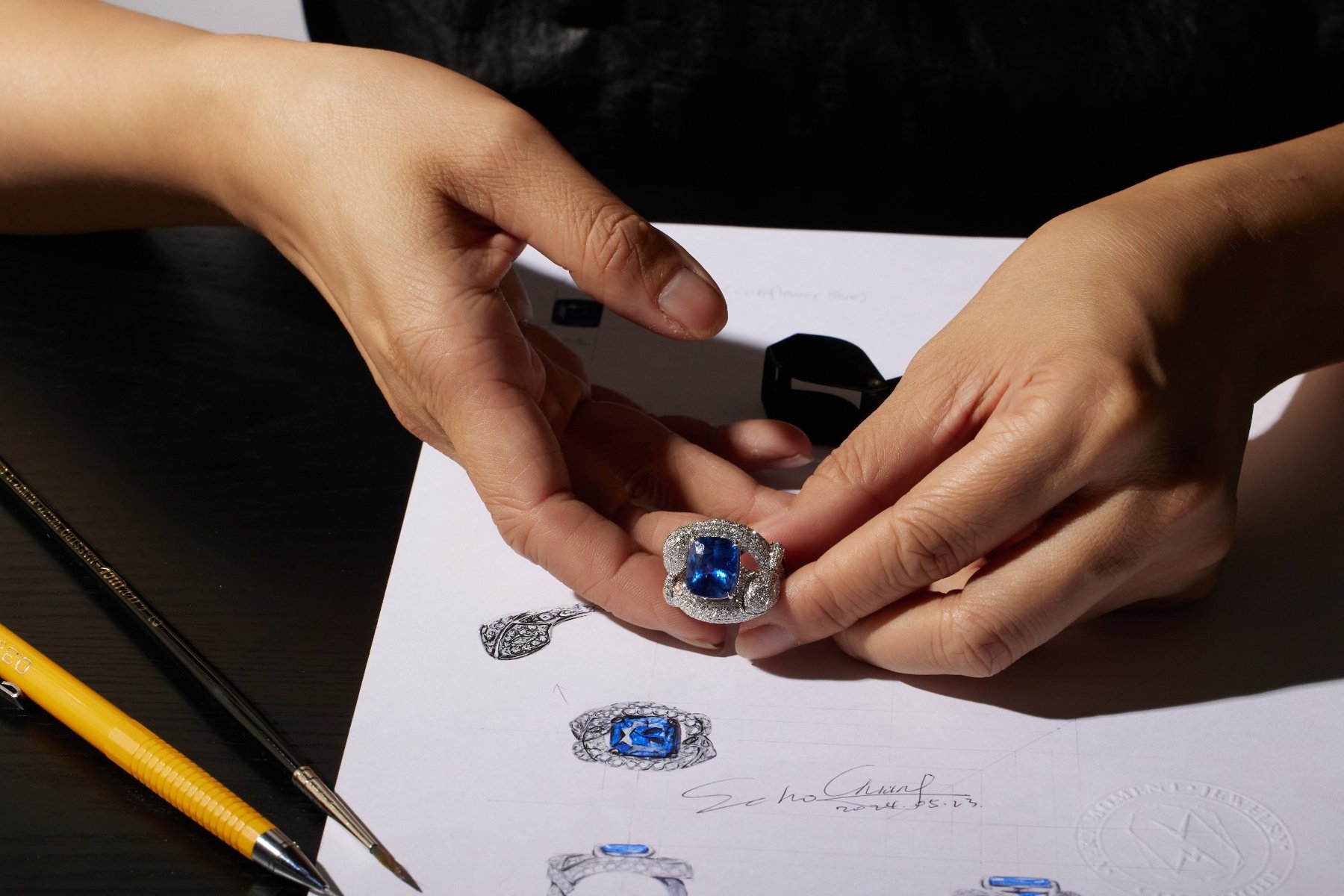
A pavé body, set along the curve. The metal is allowed to read as light rather than as mass.
Chengdu lacquer is a different craft altogether: natural sap, built up in thin layers over gold or silver, cured in a humid cabinet, then polished back before the next coat. A single surface can take months, because the material sets on its own schedule and not on the studio's.
The studio learned it as an apprenticeship in the Chengdu tradition rather than as a decorative hobby — a craft of the city that has been continuously practised and is now protected as national intangible heritage.
Lacquer and engraving belong together for a structural reason: a cut surface gives lacquer something to grip. Lines cut by the burin can hold colour the way inlay holds wire, which is not something a smooth casting can do.
“A drawer of old gold is still a stone’s story.” ON REMAKING
Nothing is quoted from a catalogue, and nothing is copied from a photograph. Five steps, in this order.
In the studio, by appointment — bring a stone, an idea, an old piece, or nothing at all. The first meeting is about what the piece is for and how often it will be worn, not about a design yet.
Either the studio sources it, or it is yours already. Colour, clarity, treatment and cut are assessed in the hand, and anything that limits the design is said before the drawing starts.
Drawn by hand, at scale, then revised until it is right. You see the piece on paper before any metal is cut; changes at this stage cost nothing but time.
Engraving, openwork, setting and finishing are done by the workshop the studio has worked with for years. Progress is checked in person, not by photograph, at each stage.
The finished piece is checked against the drawing, measured, photographed, and entered into its dossier. Cleaning, re-engraving and remaking remain available for as long as the piece exists.
Photographs flatter and photographs lie. Everything here is decided with the stone in the hand.